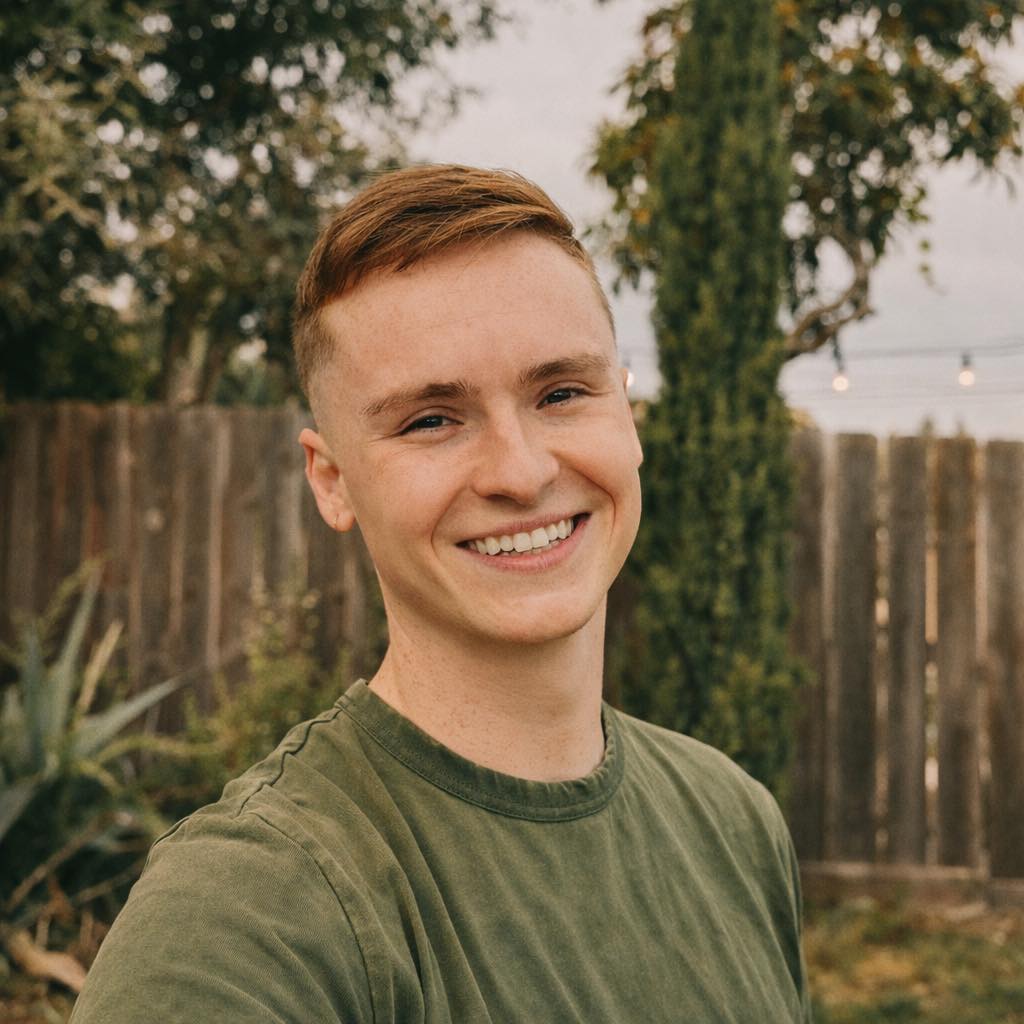
Kaleb
Zenk.
Senior Content Designer
There's a moment in writing I've always paid attention to.
When something looks finished—but you know it's not. When the sentence works, technically, but doesn't quite carry the weight it should. And you sit with it a little longer, change one word, and suddenly it holds.
That instinct has shaped how I approach this work.
I'm Kaleb—a content designer at Meta, working across AI-driven experiences and products that don't come with easy explanations. Before that, I spent time in onboarding, growth, and crypto—spaces where things are often ambiguous, high-stakes, and a little overwhelming if you don't meet people where they are.
For a long time, I thought this work was about getting the words right. And in some ways, it still is. I still care deeply about tone, rhythm, and the subtle difference between something that's technically correct and something that actually lands.
That instinct—the one that makes you sit with a sentence a beat longer than necessary—turns out to be useful far beyond the sentence itself.
But lately, I've been thinking about how much this work is changing.
Are any of us truly writing anymore?
It's a question I've been sitting with.
Because what used to feel like a linear process—choosing a word, replacing it, feeling the weight of it—now feels more like orchestration. We're shaping language through systems, structuring chaos into something usable, scalable, and coherent.
And yet, that old instinct is still there. The quiet pull toward the right word. The one that lands a little softer, or sharper, or truer.
What's changing isn't whether words matter.
It's how they matter.
As AI takes on more of the surface-level execution, the value of this work is moving upstream. It's less about the sentence, and more about the system behind the sentence. The intent. The clarity of thought. The way meaning is structured across an experience—not just written onto it.
That shift has changed how I think about my role.
I'm less focused on polishing language in isolation, and more focused on shaping understanding. On guiding decisions. On helping teams align around what users actually need to know—not just what we want to say.
Because I've come to believe that clarity isn't just a writing problem. It's a systems problem.
And that's the work I'm most interested in now—
Not just writing what's there,
but shaping what it means.
That instinct—the one that makes you sit with something a beat longer until it finally holds—it doesn't go away. It just gets applied further upstream.
That's the work.
Want to see the work?
Password-protected case studies available on request.